WHEN CRITICAL TECHNOLOGY PROJECTS START LOSING CONTROL
Restoring execution control in complex technology projects within 90 days
In critical situations, projects don’t need more reporting – they need leadership




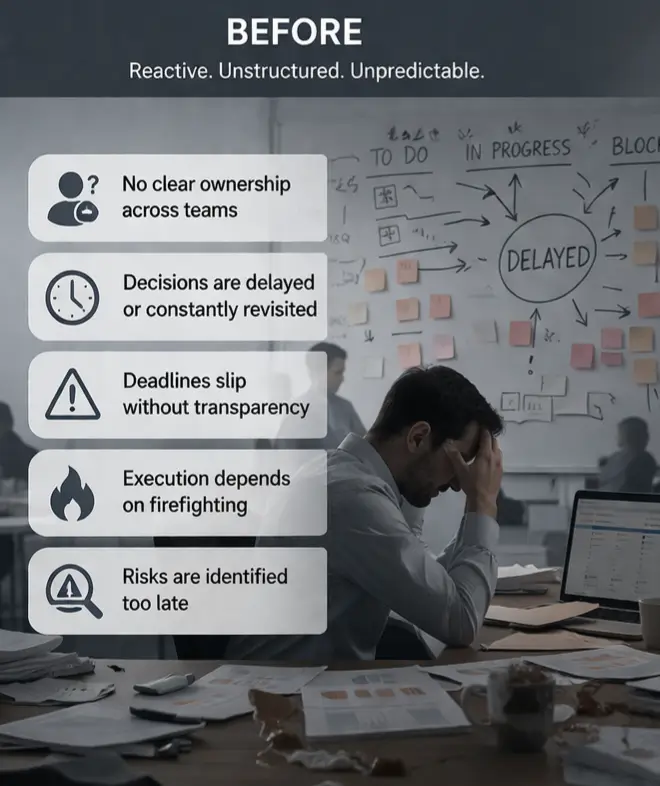
THE PATTERN
"Projects rarely fail because of effort...
...They fail because of unclear structure,
slow decisions, and unmanaged complexity."
Milestones drift
Teams lose shared direction without clear ownership structures. Small misalignments compound silently
Decisions stall
Unclear accountability turns every choice into a bottleneck. Velocity drops while urgency grows
Dependencies increase
Too many dependencies create friction. Delivery slows as alignment replaces action
Execution isolates
Project managers firefight instead of leading. The team loses confidence and chaos becomes the norm
Milestones drift
Teams lose shared direction without clear ownership structures. Small misalignments compound silently
Decisions stall
Unclear accountability turns every choice into a bottleneck. Velocity drops while urgency grows
Dependencies increase
Too many dependencies create friction. Delivery slows as alignment replaces action
Execution isolates
Project managers firefight instead of leading. The team loses confidence and chaos becomes the norm
“And then the project enters a critical phase…”
THE KYNEXT METHODOLOGY
A Structured Path to Execution Control
A time-bound, three-phase framework built for critical technology environments
PHASE 1 - Execution X-Ray
During this first phase, I assess the project’s structural stability by evaluating governance, decision-making, risk transparency, and planning robustness to uncover the root causes of execution breakdown
PHASE 2 - Execution Rescue
When projects enter a critical phase, analysis alone is not enough
During this phase, I actively stabilize the project by simplifying governance, accelerating decisions and restoring milestone reliability
PHASE 3 - Execution Architecture
Once the project is stabilized, the next step is to strengthen the execution architecture of the organization
During this phase, I help companies establish clear governance, decision frameworks, and scalable execution systems to prevent future instability
PHASE 1

Execution X-Ray
During this first phase, I assess the project’s structural stability by evaluating governance, decision-making, risk transparency, and planning robustness to uncover the root causes of execution breakdown
Diagnosis
PHASE 2
Execution Rescue
When projects enter a critical phase, analysis alone is not enough
During this phase, I actively stabilize the project by simplifying governance, accelerating decisions and restoring milestone reliability
Stabilization
PHASE 3
Execution Architecture
Once the project is stabilized, the next step is to strengthen the execution architecture of the organization
During this phase, I help companies establish clear governance, decision frameworks, and scalable execution systems to prevent future instability
Scalability
WHEN TO USE WHICH PHASE
| Situation | Recommended Phase |
|---|---|
| Project lacks clarity and direction | X-Ray |
| Execution is unstable or under pressure | Rescue |
| Need long-term scalable delivery systems | Architecture |
| Critical project needs immediate senior ownership | Interim PM |
SERVICES
Two Ways to Engage
STRUCTURED ENGAGEMENT
Project Execution Framework
A structured, time-bound approach to diagnose, stabilise, and rebuild execution in critical projects. Delivered in defined phases with clear outcomes
- Defined scope and timeline
- Phase-based delivery with clear milestones
- Measurable execution KPIs
- Built to reduce ongoing external dependency
DIRECT LEADERSHIP
Interim Project Management
Senior project leadership for high-risk or business-critical initiatives when immediate ownership and hands-on execution is required
- Immediate availability
- Full project ownership and accountability
- Escalation and stakeholder management
- Structured handover built in from day one
Next-Level Project Management with AI
Intelligent Support | Smarter Decisions | Better Outcomes
If relevant, both approaches can be enhanced with proprietary AI agents that automate repetitive PM tasks, detect risks earlier, and improve milestone and resource planning. All LLM models are hosted on the client’s own infrastructure, ensuring full GDPR compliance and that no data is ever shared with third parties.
> WHAT COWORKERS SAY
Trusted by the people who worked with it...
WHAT TO EXPECT
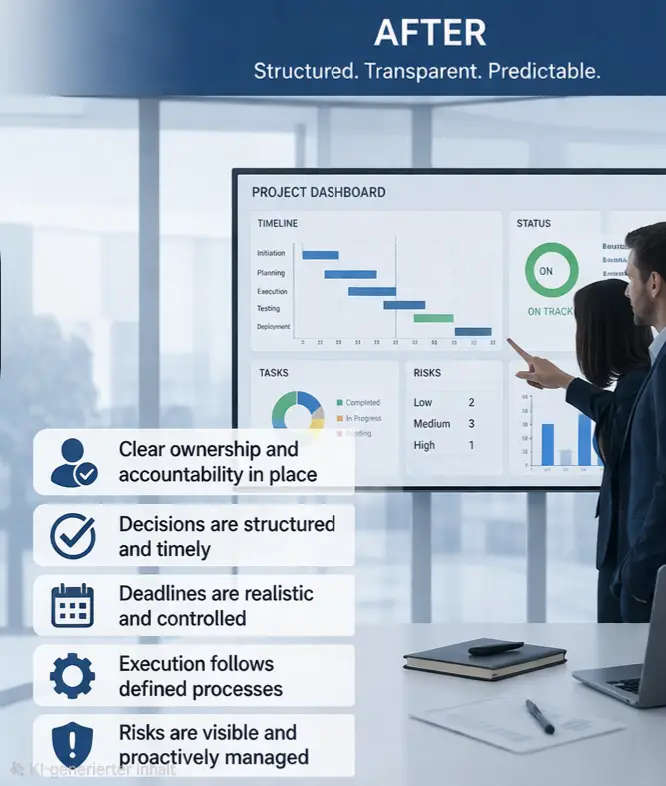
From unstable execution to predictable delivery
Restoring execution control in complex technology projects within 90 days
Is your project losing execution control?
CONTACT
Still have questions?
I look forward to your message
Use the form or reach out directly